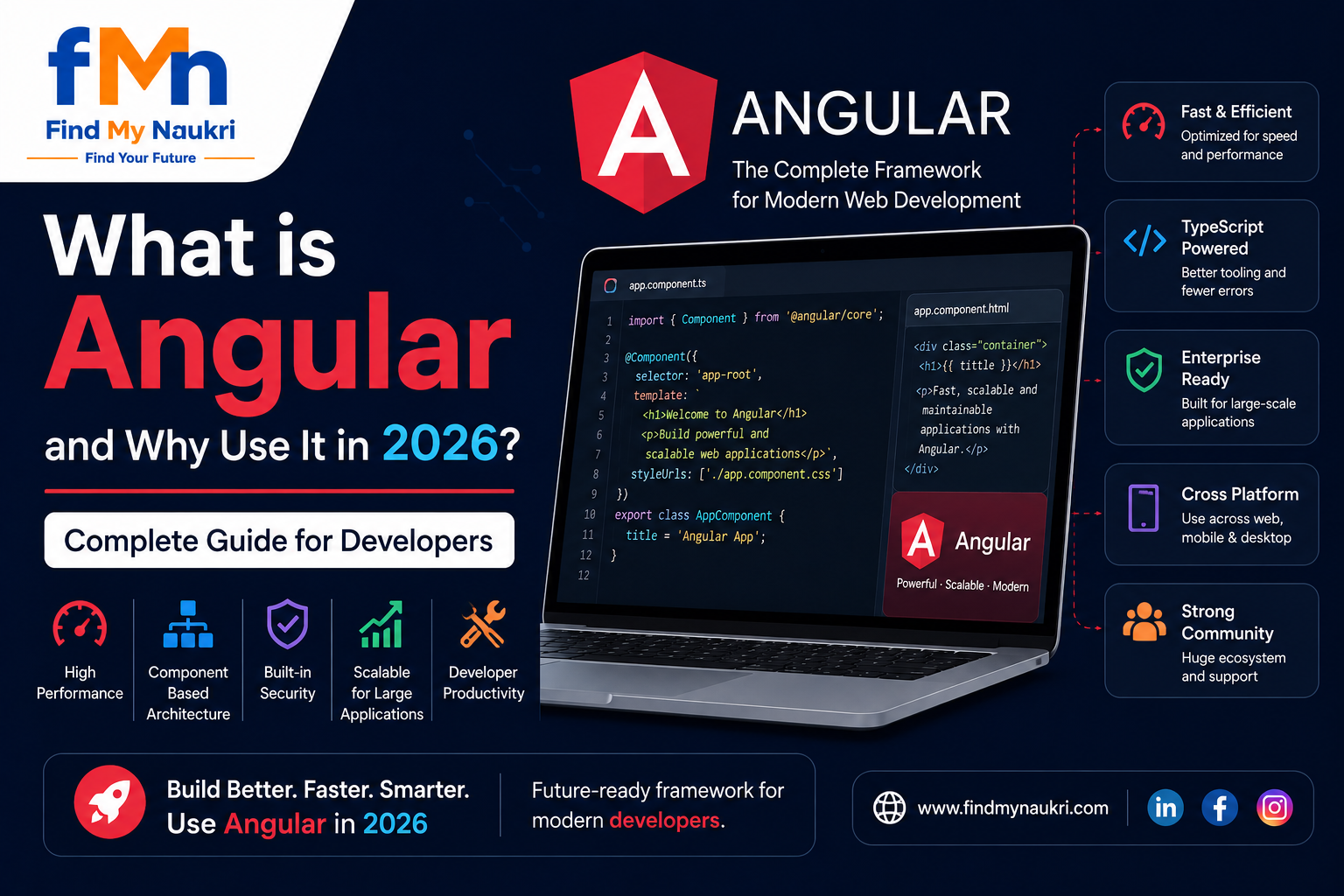
What is Angular and Why Use It in 2026?
A Complete Developer Guide to Angular Framework, Features, Benefits, and Future Scope.
📚 Table of Contents
- What is Angular?
- Key Features of Angular
- What's New in Angular 2026?
- Why Use Angular?
- Angular vs React
- When Should You Choose Angular?
- Future of Angular
- Conclusion
What is Angular?
Angular is a powerful open-source frontend framework developed and maintained by Google. It is used to build modern, scalable, high-performance web applications using TypeScript.
Angular follows a component-based architecture and provides everything needed for application development, including routing, forms, state management, dependency injection, testing, and API integration.
Key Features of Angular
1. Component-Based Architecture
Applications are divided into reusable components, making development easier and code more maintainable.
2. TypeScript Support
Angular is built with TypeScript, providing static typing, improved code quality, and better tooling support.
3. Dependency Injection
Angular's built-in dependency injection improves modularity and testing.
4. Routing
Angular includes a powerful routing system for creating Single Page Applications.
5. Reactive Forms
Build scalable and dynamic forms with validation and custom controls.
6. RxJS Integration
Reactive programming support allows efficient handling of asynchronous operations.
What's New in Angular 2026?
Standalone Components
Standalone Components remove the need for NgModules in many scenarios and simplify development.
Signals
Signals provide a simpler and more efficient way to manage application state.
Hydration & SSR
Angular now offers excellent server-side rendering and hydration support, improving SEO and performance.
Why Use Angular in 2026?
- Enterprise-Level Framework
- Long-Term Google Support
- Excellent Performance
- Strong TypeScript Integration
- Built-In Routing
- Advanced Form Handling
- Dependency Injection
- Improved SEO with SSR
- Large Community Support
- Scalable Architecture
Angular vs React
| Feature | Angular | React |
|---|---|---|
| Type | Framework | Library |
| Language | TypeScript | JavaScript |
| Routing | Built-In | External |
| Dependency Injection | Yes | No |
| Learning Curve | Moderate | Easy |
When Should You Choose Angular?
- Enterprise Applications
- CRM Systems
- ERP Software
- Healthcare Platforms
- Financial Applications
- Government Portals
- SaaS Products
- Large Team Projects
Future of Angular
Angular continues to evolve with Signals, SSR improvements, hydration, AI-powered tooling, and enhanced developer experience.
Google's commitment ensures Angular remains one of the safest frontend technologies to learn and use in 2026 and beyond.
Conclusion
Angular is a complete frontend framework that offers scalability, maintainability, performance, and enterprise-grade architecture. Whether you're building SaaS products, dashboards, enterprise systems, or SEO-focused web applications, Angular remains a top choice in 2026.