Introduction
The software development industry is evolving faster than ever. Companies are no longer hiring developers based only on programming knowledge. In 2026, businesses expect software engineers to possess a combination of technical expertise, problem-solving ability, cloud knowledge, AI awareness, and modern development practices.
A few years ago, knowing one programming language was enough to secure a software development job. Today, hiring expectations have changed dramatically. Organizations now want developers who can build scalable applications, collaborate with DevOps teams, understand cloud infrastructure, work with APIs, maintain secure coding practices, and adapt quickly to rapidly changing technologies.
The rise of Artificial Intelligence, automation tools, modern JavaScript frameworks, cloud-native applications, and remote development teams has completely reshaped hiring patterns across the global technology industry.
If you want to build a successful technology career, understanding the Top Skills Companies Look for in Software Developers has become essential.
Whether you are a beginner developer, computer science student, full stack engineer, backend developer, frontend engineer, DevOps engineer, or software tester, mastering the right skills can dramatically improve your career opportunities.
In this guide, we will explore the exact skills companies prioritize while hiring software developers in 2026.
What Skills Do Modern Companies Expect from Software Developers?
Modern companies are no longer looking for developers who simply write code. Businesses want engineers who understand how software systems work as complete products.
Today’s software developers are expected to contribute across multiple parts of development, including architecture planning, coding, testing, deployment, security, optimization, and long-term maintenance.
Hiring managers evaluate developers based on both technical and practical capabilities.
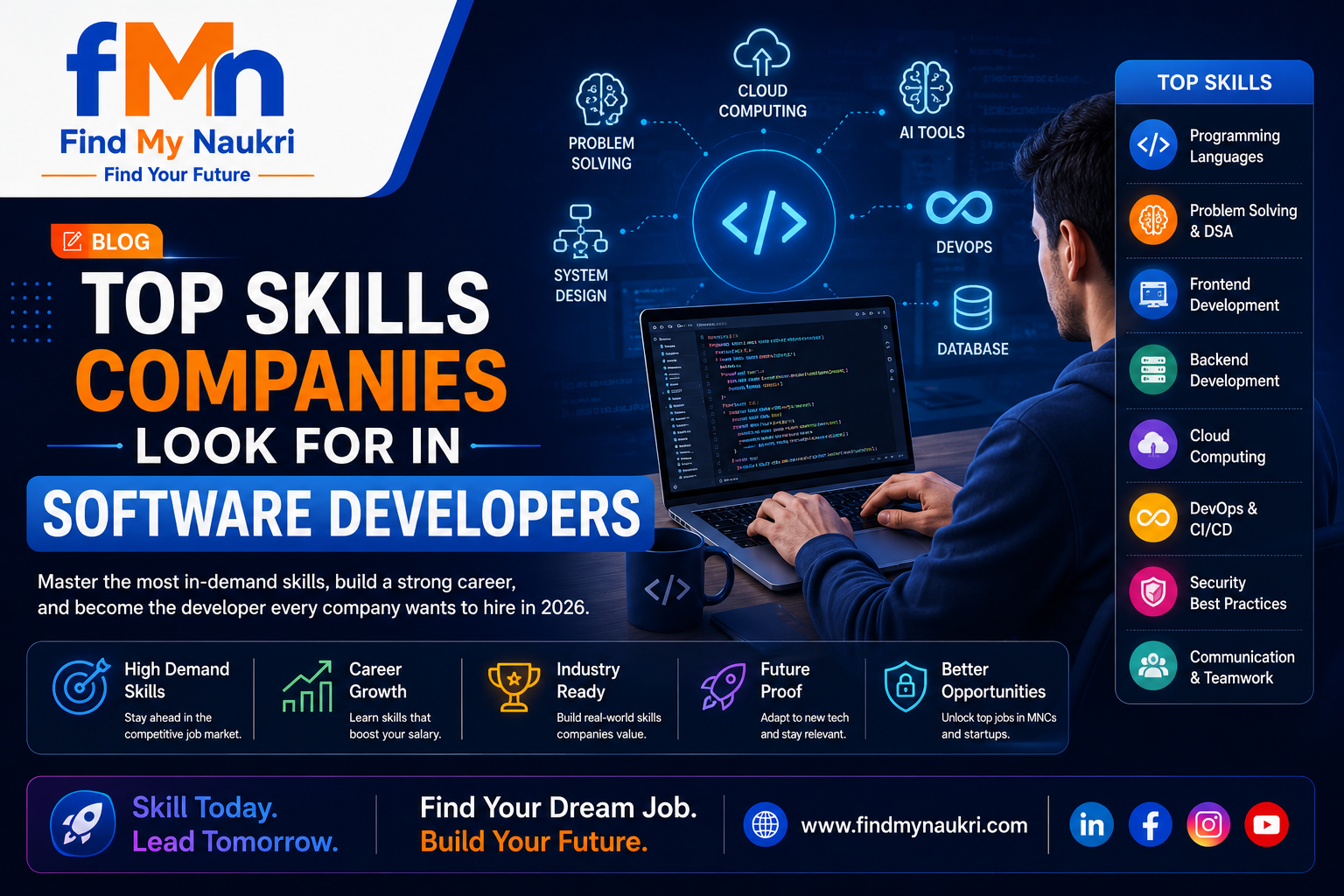
Companies typically focus on five major skill categories:
- Core programming skills
- Problem solving and logical thinking
- Framework and development ecosystem knowledge
- Cloud and DevOps understanding
- Communication and collaboration skills
The strongest candidates are developers who combine technical expertise with adaptability and continuous learning.
Why These Skills Matter in 2026
Technology companies operate in highly competitive environments. Businesses are expected to release products faster while maintaining high performance, strong security, and reliable scalability.
A developer who only writes code but lacks understanding of deployment pipelines, testing automation, cloud architecture, or system design often becomes less valuable compared to engineers with broader technical capabilities.
Industry hiring reports show companies increasingly prioritize developers who understand complete development workflows rather than isolated coding skills.
Several factors are driving this shift:
- Rapid AI adoption in development workflows
- Cloud-native software architecture
- Microservices becoming industry standard
- Security becoming critical for applications
- Remote engineering teams requiring better collaboration
- Automation reducing repetitive manual development work
This means developers must continuously upgrade their skill sets to stay competitive.
Top Skills Companies Look for in Software Developers
Below are the most important technical and professional skills companies are actively searching for.
1. Strong Programming Fundamentals
Programming fundamentals remain the foundation of software engineering.
Companies expect developers to write clean, maintainable, scalable, and optimized code.
Every software developer should have strong knowledge of:
- Variables and data structures
- Loops and conditional statements
- Functions and reusable code
- Object Oriented Programming
- Error handling
- Memory optimization
- Code architecture
Popular programming languages companies actively hire for:
- JavaScript
- Python
- PHP
- Java
- C#
- GoLang
- TypeScript
Without strong programming fundamentals, learning advanced technologies becomes difficult.
2. Problem Solving and Data Structures
One of the biggest differences between average developers and highly paid engineers is problem-solving ability.
Top technology companies heavily test:
- Algorithms
- Data Structures
- Optimization logic
- Time complexity
- Space complexity
- Logical reasoning
Important concepts developers must understand:
- Arrays
- Linked Lists
- Stacks
- Queues
- Trees
- Recursion
- Sorting Algorithms
- Searching Algorithms
- Dynamic Programming
- Graph Algorithms
Strong problem-solving ability significantly improves job opportunities.
3. Frontend Development Skills
Modern companies want developers who understand how users interact with applications.
Frontend development knowledge has become essential even for many backend engineers.
Key frontend technologies:
- HTML5
- CSS3
- JavaScript
- Responsive Design
- REST API Integration
- State Management
- Browser Performance Optimization
Most demanded frontend frameworks:
- React.js
- Next.js
- Angular
- Vue.js
4. Backend Development Expertise
Backend systems power modern applications. Businesses need developers who understand server-side architecture.
Important backend skills include:
- REST API Development
- Authentication Systems
- Database Design
- Session Management
- Caching
- Security Implementation
- Performance Optimization
Popular backend technologies:
- Laravel
- Node.js
- Express.js
- Django
- Spring Boot
- .NET Core
5. Database Management Skills
Applications rely heavily on data. Companies expect developers to understand database design and optimization.
Important database knowledge:
- SQL Queries
- Joins
- Indexes
- Normalization
- Stored Procedures
- Database Security
- Query Optimization
Popular databases:
- MySQL
- PostgreSQL
- MongoDB
- Redis
- Firebase
6. Cloud Computing Skills
Cloud computing is now one of the most demanded skills worldwide.
Companies increasingly deploy applications on cloud infrastructure instead of traditional servers.
Developers should understand:
- Virtual Servers
- Cloud Storage
- Load Balancing
- CDN Systems
- Cloud Security
- Scalability Architecture
Popular cloud platforms:
- AWS
- Microsoft Azure
- Google Cloud Platform
7. DevOps and CI/CD Knowledge
Companies increasingly expect developers to understand deployment automation.
DevOps helps teams release software faster and more reliably.
Important DevOps tools:
- Docker
- Kubernetes
- GitHub Actions
- Jenkins
- Terraform
- Ansible
- CI/CD Pipelines
8. API Development and Integration
Modern software systems constantly communicate through APIs.
Companies expect developers to understand:
- REST APIs
- JSON Data Handling
- Authentication Tokens
- OAuth
- API Security
- Rate Limiting
- Third Party Integrations
9. AI Tools and Automation Skills
In 2026, developers are increasingly expected to understand AI-powered development workflows.
Companies want engineers who know how to use AI productively.
Popular AI development tools:
- OpenAI
- GitHub Copilot
- Claude AI
- Cursor AI
- Gemini AI
Developers who know AI-assisted coding workflows often complete projects significantly faster.
10. Communication and Team Collaboration
Technical skills alone are not enough.
Modern development teams work remotely across multiple countries and departments.
Companies expect developers to communicate clearly with:
- Product Managers
- Design Teams
- QA Engineers
- DevOps Engineers
- Clients
- Security Teams
Poor communication often causes project delays even when technical work is strong.
Skill Comparison Table for Software Developers
| Skill | Importance Level | Career Impact |
|---|---|---|
| Programming Fundamentals | Very High | Core Requirement |
| Problem Solving | Very High | Interview Success |
| Cloud Computing | High | Better Salary |
| DevOps | High | Enterprise Hiring |
| AI Tools | High | Future Ready Career |
| Communication Skills | High | Team Leadership |
Step-by-Step Guide to Become an Industry-Ready Developer
Step 1
Master one programming language deeply.
Step 2
Learn Data Structures and Algorithms.
Step 3
Build real-world projects.
Step 4
Learn one frontend framework.
Step 5
Master backend development.
Step 6
Understand databases and optimization.
Step 7
Learn Git and version control.
Step 8
Learn Docker and deployment pipelines.
Step 9
Understand cloud computing basics.
Step 10
Practice interview problem solving daily.
Common Mistakes Developers Make
- Learning too many programming languages without mastering one
- Ignoring Data Structures and Algorithms
- Not building real-world projects
- Skipping Git and version control
- Ignoring cloud computing
- Not learning deployment processes
- Ignoring AI development tools
- Poor communication skills
- Depending only on online tutorials
- Not preparing for coding interviews
Frequently Asked Questions
Which programming language is best for software developers in 2026?
JavaScript, Python, Java, PHP, and TypeScript remain highly demanded.
Is AI replacing software developers?
No. AI is becoming a productivity tool, but companies still need skilled engineers.
Do companies require cloud computing knowledge?
Yes. Cloud skills are becoming essential in almost every software engineering role.
Is DevOps important for developers?
Absolutely. Understanding deployment pipelines increases career value significantly.
Do freshers need system design knowledge?
Basic architecture understanding helps developers grow faster.
Conclusion
The software development industry is becoming increasingly competitive. Companies in 2026 are no longer hiring developers based only on coding ability. Businesses want engineers who understand complete software development ecosystems.
Developers who build expertise in programming fundamentals, problem solving, frontend frameworks, backend architecture, cloud computing, DevOps, API development, AI-powered development tools, and communication skills will have significantly better career opportunities.
Technology changes rapidly, and continuous learning has become the biggest advantage for software developers.
The future belongs to developers who adapt faster than the industry changes.