Introduction
The digital world has evolved faster than ever before. Businesses are moving to the cloud, employees are working remotely, artificial intelligence is becoming part of daily operations, and billions of connected devices communicate over the internet every second. While these technological advancements create incredible opportunities, they also introduce new security challenges that cybercriminals are eager to exploit.
Cybersecurity is no longer just an IT department's responsibility. It has become a business priority, a national security concern, and an essential life skill for anyone using the internet. Whether you are an individual managing online banking, a student accessing educational platforms, a software developer building applications, or a multinational company protecting customer information, cybersecurity affects everyone.
The year 2026 represents a significant shift in the cybersecurity landscape. Artificial Intelligence has made cyberattacks more sophisticated than ever before. Hackers now use automation, machine learning, deepfake technology, and intelligent malware to bypass traditional security systems. At the same time, organizations are storing more sensitive information online, making them attractive targets for cybercriminals.
According to cybersecurity researchers, organizations across the world experience millions of attempted cyberattacks every day. Financial institutions, healthcare providers, educational organizations, government agencies, startups, and even small businesses have become common targets for ransomware, phishing attacks, credential theft, and cloud security breaches.
Many people mistakenly believe that cybercriminals only target large corporations. In reality, small businesses and individual users are often easier targets because they typically have fewer security controls, outdated software, and limited cybersecurity awareness.
The consequences of a successful cyberattack can be devastating. Businesses may suffer financial losses, operational downtime, damaged reputation, legal penalties, customer trust issues, and even permanent closure. Individuals may lose sensitive personal information, banking credentials, social media accounts, or become victims of identity theft.
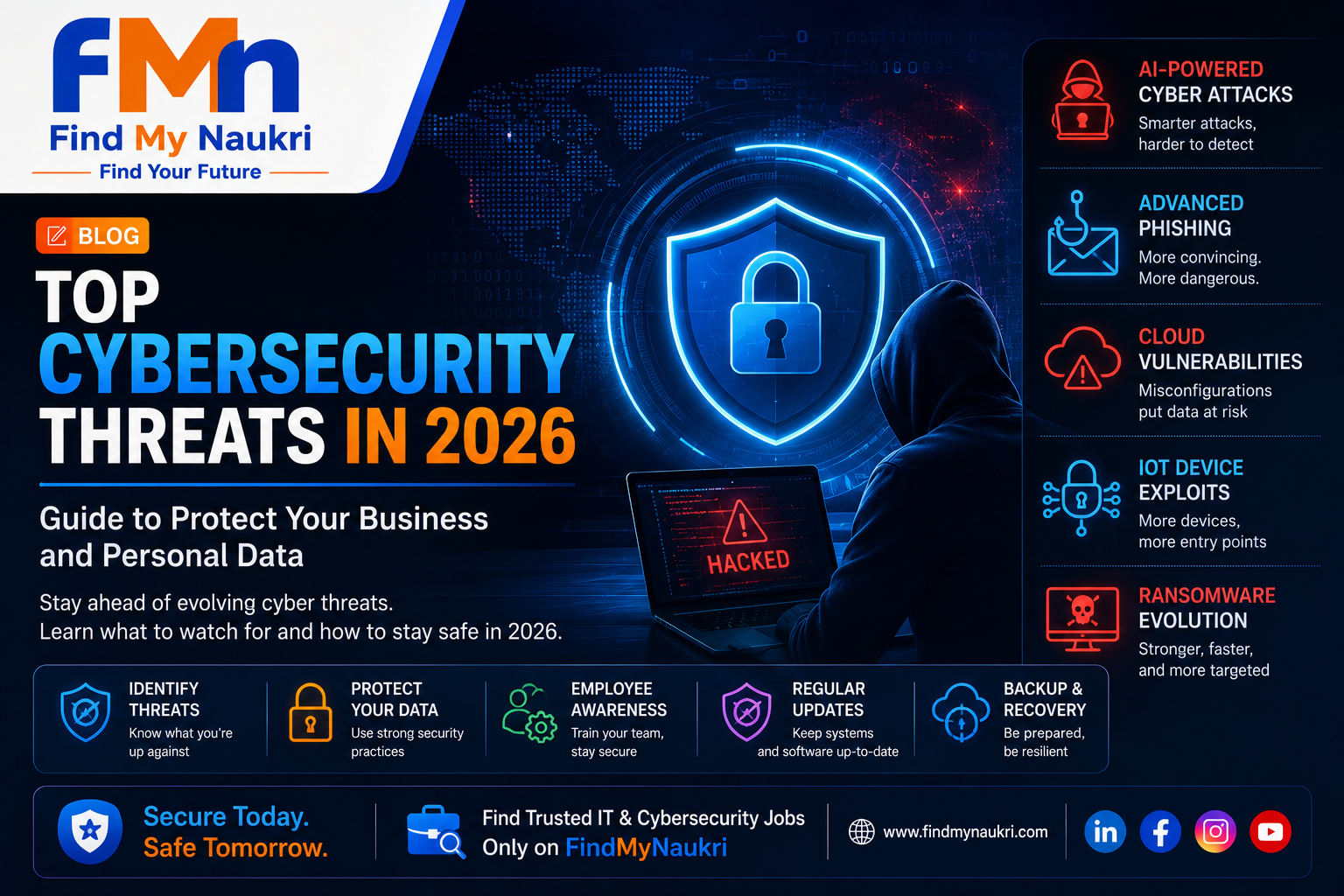
This comprehensive guide explores the most significant cybersecurity threats expected in 2026, explains how these attacks work, identifies who is most at risk, and provides practical recommendations to help individuals and organizations strengthen their cybersecurity defenses.
What is Cybersecurity?
Cybersecurity refers to the practice of protecting computers, servers, mobile devices, cloud platforms, applications, digital infrastructure, and sensitive information from unauthorized access, cyberattacks, malware infections, ransomware, and data breaches.
Its primary objective is to ensure the confidentiality, integrity, and availability of digital information. A strong cybersecurity strategy helps prevent attackers from stealing confidential data, disrupting business operations, manipulating systems, or causing financial damage.
Modern cybersecurity combines technology, policies, employee awareness, risk management, and continuous monitoring. Simply installing antivirus software is no longer enough because modern cyber threats constantly evolve and become more sophisticated.
Major Components of Cybersecurity
- Network Security
Network security protects communication between computers, servers, routers, and cloud services. Firewalls, intrusion detection systems, VPNs, and secure network configurations help prevent unauthorized users from accessing organizational resources. - Application Security
Application security focuses on building secure software by identifying vulnerabilities during development. Secure coding practices, vulnerability scanning, penetration testing, and regular updates reduce the chances of attackers exploiting software weaknesses. - Cloud Security
Cloud security protects applications, databases, storage, and workloads hosted on cloud platforms. Organizations implement encryption, identity management, access controls, and continuous monitoring to secure cloud environments. - Data Security
Sensitive information such as customer records, financial transactions, healthcare information, and business documents must be protected through encryption, backups, access controls, and secure storage practices. -
Identity and Access Management (IAM)
IAM ensures that only authorized users can access specific systems or resources. Multi-factor authentication, role-based permissions, and strong password policies significantly reduce unauthorized access. -
Endpoint Security
Every laptop, smartphone, desktop computer, and tablet connected to a network becomes an endpoint. Endpoint protection software detects malware, ransomware, suspicious behavior, and unauthorized applications. -
Operational Security
Operational security involves developing security policies, employee training programs, incident response procedures, and disaster recovery plans that help organizations respond effectively during cyber incidents.
Why Cybersecurity Matters More Than Ever in 2026
Cybersecurity has become a strategic investment rather than simply an IT expense. As digital transformation accelerates worldwide, cybercriminals continue discovering new ways to exploit organizations using advanced technologies.
-
Artificial Intelligence Makes Attackers More Powerful
AI now enables hackers to automate phishing campaigns, write malicious code, identify software vulnerabilities faster, and launch intelligent cyberattacks at massive scale. This significantly increases both the speed and sophistication of modern cybercrime. -
Remote Work Expands the Attack Surface
Employees now connect from homes, coffee shops, airports, and public Wi-Fi networks using multiple devices. Each additional connection creates another possible entry point that attackers may attempt to exploit. -
Cloud Adoption Continues to Grow
Businesses increasingly rely on cloud platforms to store critical applications and sensitive customer information. Misconfigured cloud services remain one of the leading causes of data breaches worldwide. -
Digital Payments Continue Rising
Online banking, UPI transactions, mobile wallets, cryptocurrency, and digital payment platforms have become common targets for cybercriminals seeking financial gain. -
Internet of Things Devices Are Everywhere
Smart cameras, medical devices, industrial sensors, home automation systems, and connected vehicles often lack adequate security, making them attractive targets for attackers. -
Businesses Depend Entirely on Technology
Even a few hours of system downtime can interrupt customer services, delay production, damage reputation, and result in significant financial losses.
Current Cybersecurity Landscape in 2026
The cybersecurity landscape in 2026 is characterized by rapidly evolving threats, increasingly sophisticated attackers, and growing reliance on Artificial Intelligence by both defenders and cybercriminals.
Traditional antivirus software alone is no longer sufficient. Organizations now combine AI-powered threat detection, Zero Trust Architecture, Extended Detection and Response (XDR), Endpoint Detection and Response (EDR), Security Information and Event Management (SIEM), behavioral analytics, and continuous monitoring to defend against emerging cyber threats.
Cybersecurity professionals predict that ransomware, AI-generated phishing emails, deepfake fraud, supply chain compromises, cloud misconfigurations, and zero-day vulnerabilities will remain among the most dangerous cyber risks throughout 2026.
Top Cybersecurity Threats in 2026
As technology continues to evolve, cybercriminals constantly adapt their tactics. Understanding the latest cyber threats helps individuals and organizations prepare stronger defenses before attackers exploit vulnerabilities.
In the following sections, we will explore the most dangerous cybersecurity threats expected to dominate 2026, how these attacks operate, who is most at risk, and the best practices to defend against them.
1. AI Powered Cyber Attacks
Artificial Intelligence is transforming cybersecurity but it is also empowering cybercriminals. Attackers are increasingly using AI to automate attacks, identify vulnerabilities, generate convincing phishing emails, write malicious software, and bypass traditional security defenses.
Unlike traditional attacks that often require manual effort, AI powered cyberattacks can analyze massive amounts of information within seconds, allowing attackers to launch personalized and highly effective campaigns against individuals and organizations.
How AI Is Being Used by Cybercriminals
-
Automated Phishing Campaigns
AI can generate highly personalized phishing emails by analyzing publicly available information from social media, company websites, and online profiles. These messages appear legitimate, making them much harder to identify than traditional phishing emails. -
Intelligent Malware Development
Modern malware can change its behavior automatically to avoid antivirus detection. AI enables malicious software to adapt, hide, and evolve while remaining active inside compromised systems. -
Password Guessing and Credential Attacks
Machine learning algorithms analyze leaked password databases to predict commonly used password combinations, increasing the success rate of brute-force attacks. -
Automated Vulnerability Discovery
Instead of manually searching for software weaknesses, AI systems can scan thousands of applications and identify potential vulnerabilities much faster than human attackers.
Why AI Powered Cyber Attacks Are So Dangerous
Artificial Intelligence allows cybercriminals to launch attacks at a scale that was previously impossible. Instead of manually targeting one victim at a time, attackers can now automate thousands of attacks simultaneously while continuously improving their techniques based on the responses they receive.
Traditional security systems rely on predefined rules and known malware signatures. AI-generated attacks constantly modify their behavior, making detection much more difficult. This creates a continuous battle between cybersecurity professionals and cybercriminals.
Real-World Examples
-
AI Generated Phishing Emails
Instead of poorly written phishing messages, attackers now create emails with perfect grammar, personalized information, and professional formatting. Many victims cannot distinguish these emails from legitimate business communications. -
Automated Vulnerability Scanning
Cybercriminals use AI to scan millions of websites, APIs, and cloud servers for security weaknesses within minutes. Once a vulnerability is discovered, automated exploitation begins immediately. -
AI Powered Social Engineering
Attackers collect information from LinkedIn, Facebook, company websites, and public databases to craft highly convincing messages that manipulate employees into revealing confidential information.
How to Protect Yourself
-
Implement AI-Based Security Solutions
Organizations should adopt modern security platforms that use machine learning to detect unusual user behavior and suspicious network activity in real time. -
Employee Awareness Training
Regular cybersecurity awareness training helps employees recognize AI-generated phishing attempts and reduces the likelihood of human error. -
Enable Multi-Factor Authentication
Even if passwords are compromised, multi-factor authentication provides an additional layer of protection against unauthorized access. -
Monitor User Behavior
Behavioral analytics can identify unusual login patterns, abnormal data transfers, and suspicious account activities before attackers cause significant damage.
2. Advanced Ransomware Attacks
Ransomware continues to be one of the most financially damaging cyber threats worldwide. In 2026, ransomware has evolved far beyond simply encrypting files. Modern ransomware groups now combine encryption, data theft, extortion, and public exposure to maximize pressure on victims.
Cybercriminal organizations operate like professional businesses. They have dedicated development teams, customer support portals, payment systems, affiliate programs, and even negotiation specialists who communicate directly with victims.
How Modern Ransomware Works
-
Initial System Compromise
Attackers gain access through phishing emails, stolen credentials, software vulnerabilities, or unsecured remote desktop services. Once inside the network, they quietly expand their access before launching the ransomware. -
Privilege Escalation
Instead of encrypting files immediately, attackers attempt to gain administrator privileges. This allows them to disable security software, delete backups, and access sensitive business information. -
Data Exfiltration
Modern ransomware operators steal confidential business data before encryption. If the victim refuses to pay, the stolen information is published or sold on underground marketplaces. -
Mass Encryption
After stealing sensitive information, ransomware encrypts servers, databases, employee computers, virtual machines, cloud storage, and backup systems simultaneously. -
Double and Triple Extortion
Attackers may demand payment for file recovery, threaten to leak confidential information, and even contact customers or business partners to increase pressure on the victim organization.
Industries Frequently Targeted
-
Healthcare Organizations
Hospitals depend heavily on digital systems. Any disruption can delay patient treatment, making healthcare organizations attractive targets for ransomware operators. -
Financial Institutions
Banks and financial service providers store highly valuable customer information and financial records, making them profitable targets. -
Educational Institutions
Universities and schools often manage thousands of student records while operating with limited cybersecurity budgets. -
Government Agencies
Government departments hold sensitive citizen information and provide essential public services that attackers may attempt to disrupt. -
Manufacturing Companies
Manufacturing plants increasingly rely on automated systems. Production downtime caused by ransomware can result in enormous financial losses.
Warning Signs of a Ransomware Attack
-
Unexpected File Encryption
Documents suddenly become inaccessible, and file extensions change to unfamiliar formats created by ransomware. -
Unusual Network Activity
Large amounts of internal network traffic or unexpected communication with unknown servers may indicate ransomware preparation. -
Disabled Security Software
Attackers often disable antivirus software, endpoint protection, or security monitoring before executing ransomware. -
Unauthorized User Accounts
New administrator accounts or unexpected privilege changes may indicate attackers are preparing for deployment.
Best Practices to Prevent Ransomware
-
Maintain Offline Backups
Store encrypted backups offline and regularly test recovery procedures. Offline backups remain one of the most effective defenses against ransomware. -
Keep Systems Updated
Apply security patches immediately after release to eliminate vulnerabilities commonly exploited by ransomware groups. -
Restrict Administrative Access
Provide administrator privileges only to employees who genuinely require them, reducing opportunities for attackers to escalate privileges. -
Deploy Endpoint Detection and Response (EDR)
Modern EDR solutions monitor system behavior continuously and can isolate infected devices before ransomware spreads across the network. -
Conduct Security Awareness Training
Employees should understand how phishing emails, malicious attachments, and suspicious links contribute to ransomware infections.
3. Supply Chain Attacks
Supply chain attacks have become one of the fastest-growing cybersecurity threats because attackers no longer focus solely on the final target. Instead, they compromise trusted software vendors, cloud service providers, hardware manufacturers, or third-party service providers to gain access to thousands of organizations simultaneously.
This approach allows cybercriminals to infect multiple businesses through a single compromised software update or trusted vendor relationship, making supply chain attacks both efficient and extremely dangerous.
How Supply Chain Attacks Work
-
Compromising Software Vendors
Attackers infiltrate software development environments and inject malicious code into legitimate software updates distributed to customers. -
Targeting Third-Party Service Providers
Businesses often trust external vendors with access to internal systems. Attackers exploit weaker vendor security to reach larger organizations. -
Hardware Component Manipulation
Malicious modifications during manufacturing or distribution can introduce hidden vulnerabilities before devices even reach customers. -
Open Source Dependency Attacks
Modern applications rely on thousands of open-source packages. Attackers compromise these dependencies to spread malicious code across countless projects.
Why Supply Chain Attacks Are Increasing
-
Businesses Depend on Third-Party Software
Organizations increasingly rely on cloud services, SaaS platforms, APIs, and external software libraries, expanding the overall attack surface. -
Trust Relationships Reduce Suspicion
Software updates from trusted vendors are often installed automatically, allowing malicious code to bypass traditional security reviews. -
One Attack Can Affect Thousands of Organizations
Instead of attacking companies individually, compromising one trusted supplier may provide access to hundreds or thousands of customers.
How Organizations Can Protect Their Supply Chains
-
Perform Vendor Security Assessments
Before partnering with any third-party vendor, organizations should evaluate their cybersecurity policies, compliance certifications, and incident response capabilities. Regular security reviews help identify potential weaknesses before they become security risks. -
Verify Software Integrity
Always verify digital signatures and software checksums before installing updates. This helps ensure that downloaded software has not been modified by attackers during distribution. -
Monitor Third-Party Access
External vendors should receive only the minimum level of access required to perform their work. Limiting permissions reduces the impact if a vendor account becomes compromised. -
Maintain an Inventory of Dependencies
Development teams should keep track of all third-party libraries, APIs, and open-source packages used within applications. This enables faster response when vulnerabilities are discovered.
4. Cloud Security Threats
Cloud computing has become the foundation of modern businesses. Organizations rely on cloud platforms to host applications, store sensitive customer information, process financial transactions, and manage critical workloads. While cloud technology provides flexibility and scalability, it also introduces new cybersecurity challenges.
Most cloud security incidents are not caused by weaknesses in cloud providers themselves but rather by incorrect configurations, weak access controls, and poor security practices implemented by organizations.
Common Cloud Security Risks
-
Misconfigured Cloud Storage
Improperly configured cloud storage buckets may accidentally expose confidential documents, customer databases, financial records, or internal business information to the public internet. -
Weak Identity Management
Cloud accounts protected only by passwords are highly vulnerable to credential theft. Attackers frequently target privileged cloud administrator accounts. -
Insecure APIs
Cloud services communicate through APIs. Poorly secured APIs may allow attackers to access sensitive information, modify resources, or compromise applications. -
Insufficient Monitoring
Without continuous monitoring, organizations may fail to detect unauthorized access, suspicious login attempts, or malicious activities occurring inside cloud environments. -
Shared Responsibility Misunderstanding
Many organizations incorrectly assume cloud providers handle all security. In reality, customers remain responsible for securing their own applications, data, identities, and configurations.
Cloud Security Best Practices
-
Enable Multi-Factor Authentication
Require MFA for all administrator accounts to prevent attackers from accessing cloud services using stolen credentials. -
Encrypt Sensitive Information
Use encryption both during data transmission and while data is stored. Encryption significantly reduces the risk of data exposure. -
Regular Security Audits
Conduct frequent cloud configuration reviews to identify exposed storage, excessive permissions, and security misconfigurations. -
Continuous Monitoring
Implement cloud monitoring solutions that generate alerts whenever unusual login attempts, privilege changes, or suspicious network activity occurs. -
Apply Least Privilege Access
Users should receive only the permissions necessary for their responsibilities, minimizing opportunities for unauthorized access.
5. Deepfake and AI-Powered Fraud
Artificial Intelligence has introduced a new generation of cybercrime through deepfake technology. Attackers can now generate realistic videos, voice recordings, and images that closely resemble real individuals, making social engineering attacks more convincing than ever before.
Businesses increasingly rely on video conferencing, remote communication, and digital identity verification. Deepfake technology exploits this trust by creating fake communications that appear completely authentic.
How Deepfake Attacks Work
-
Voice Cloning
Cybercriminals can clone the voice of company executives using only a few minutes of publicly available audio, enabling fraudulent financial requests or confidential information theft. -
Fake Video Meetings
AI-generated video content can imitate business leaders during online meetings, convincing employees to authorize financial transfers or reveal confidential information. -
Identity Fraud
Deepfake images and videos may be used to bypass identity verification systems during account creation or financial transactions. -
Political and Social Manipulation
False videos distributed online may spread misinformation, damage reputations, or manipulate public opinion.
How to Defend Against Deepfake Attacks
-
Verify Sensitive Requests
Financial transfers or confidential requests should always be verified through multiple communication channels before approval. -
Educate Employees
Security awareness training should include demonstrations of deepfake technology and methods for recognizing suspicious communications. -
Use AI Detection Tools
Advanced detection systems analyze inconsistencies in voice patterns, facial movements, and digital artifacts to identify manipulated media. -
Implement Strong Verification Procedures
Organizations should establish formal approval workflows for high-risk business decisions rather than relying solely on voice or video communication.
6. Phishing and Social Engineering Attacks
Phishing remains one of the most successful cyberattack methods because it targets human psychology rather than technical vulnerabilities. Instead of hacking computers directly, attackers manipulate people into revealing passwords, financial information, or confidential business data.
Modern phishing attacks are significantly more convincing than those seen a few years ago. AI-generated content, personalized messages, and realistic websites make fraudulent communications increasingly difficult to identify.
Types of Phishing Attacks
-
Email Phishing
Fraudulent emails impersonate trusted organizations and encourage victims to click malicious links or download infected attachments. -
Spear Phishing
Unlike mass phishing campaigns, spear phishing targets specific individuals using personalized information collected from social media and public sources. -
Business Email Compromise (BEC)
Attackers impersonate executives or finance departments to convince employees to transfer funds or disclose confidential information. -
SMS Phishing (Smishing)
Fraudulent text messages direct victims to fake websites that steal login credentials or banking information. -
Voice Phishing (Vishing)
Phone calls impersonating banks, government agencies, or technical support attempt to manipulate victims into revealing confidential information.
How to Prevent Phishing
-
Think Before Clicking
Employees should carefully examine email addresses, links, and attachments before interacting with suspicious messages. -
Use Email Security Solutions
Modern email filtering systems detect malicious links, suspicious attachments, and fraudulent sender identities. -
Enable Multi-Factor Authentication
Even if attackers steal passwords through phishing, MFA significantly reduces the likelihood of successful account compromise. -
Conduct Regular Phishing Simulations
Organizations should periodically test employee awareness through simulated phishing campaigns.
7. Zero Day Vulnerabilities
One of the most dangerous cybersecurity threats in 2026 is the increasing number of zero-day vulnerabilities. A zero day vulnerability is a software flaw that is unknown to the software vendor and therefore has no security patch available at the time attackers begin exploiting it.
Because there is no official fix available, attackers have a significant advantage. Organizations often remain vulnerable until developers identify the issue, create a security patch, and businesses deploy the update across their systems.
How Zero-Day Attacks Work
-
Discovery of Unknown Vulnerabilities
Cybercriminals or security researchers discover previously unknown weaknesses inside operating systems, web browsers, enterprise software, or cloud platforms before the software vendor becomes aware of the issue. -
Rapid Exploitation
Once discovered, attackers develop exploits that can compromise vulnerable systems before organizations have time to implement protective measures. -
Stealth Operations
Since antivirus vendors are unaware of the exploit, traditional signature-based detection systems often fail to recognize malicious activity. -
Large Scale Impact
A single zero-day vulnerability affecting popular software can expose millions of computers worldwide within hours.
Protection Strategies
-
Apply Security Updates Immediately
Organizations should deploy software updates as soon as vendors release security patches to minimize exposure. -
Use Endpoint Detection and Response (EDR)
Behavior-based detection systems can identify suspicious activities even when malware signatures are unknown. -
Implement Network Segmentation
Separating business systems limits attacker movement if one device becomes compromised. -
Perform Continuous Vulnerability Scanning
Regular scanning helps identify outdated software before attackers exploit it.
8. Internet of Things (IoT) Device Attacks
The Internet of Things has transformed homes, healthcare, transportation, and manufacturing. Smart cameras, wearable devices, industrial sensors, connected vehicles, and smart home appliances all communicate over the internet. Unfortunately, many IoT devices were designed with convenience in mind rather than security.
Cybercriminals increasingly target IoT devices because they often use weak passwords, outdated firmware, and limited security protections.
Common IoT Security Risks
-
Default Passwords
Many users never change factory default passwords, allowing attackers to compromise devices using publicly available credentials. -
Outdated Firmware
Manufacturers may stop releasing updates, leaving devices permanently vulnerable to known exploits. -
Weak Encryption
Some IoT devices transmit sensitive information without proper encryption, making interception easier. -
Botnet Recruitment
Compromised IoT devices are commonly used to build massive botnets capable of launching Distributed Denial-of-Service (DDoS) attacks.
IoT Security Best Practices
-
Change Default Credentials
Replace default usernames and passwords immediately after installing any connected device. -
Keep Firmware Updated
Install firmware updates regularly to protect against newly discovered vulnerabilities. -
Separate IoT Networks
Place smart devices on isolated Wi-Fi networks instead of connecting them directly to business-critical systems. -
Disable Unused Features
Turn off remote access, Bluetooth, or unnecessary services that are not actively required.
9. API Security Risks
Modern software applications rely heavily on Application Programming Interfaces (APIs). APIs enable communication between websites, mobile applications, cloud services, payment gateways, and third-party integrations. As organizations expose more APIs, attackers increasingly target insecure endpoints to steal sensitive information or manipulate systems.
Major API Threats
-
Broken Authentication
Weak authentication mechanisms allow attackers to impersonate legitimate users and gain unauthorized access to protected resources. -
Broken Authorization
Improper permission checks may allow users to access information belonging to other customers. -
Excessive Data Exposure
Poorly designed APIs sometimes return unnecessary sensitive information that attackers can exploit. -
Rate Limiting Failures
Without request limits, attackers can launch brute-force attacks or overwhelm API services. -
Injection Attacks
Unsanitized user input can lead to SQL Injection, Command Injection, or NoSQL Injection attacks.
API Protection Measures
-
Use OAuth and Secure Authentication
Implement modern authentication standards with secure token management. -
Validate All User Input
Input validation reduces injection attacks and malicious requests. -
Enable Rate Limiting
Restrict request frequency to minimize abuse. -
Encrypt API Communications
Use HTTPS and TLS encryption for all API traffic.
10. Insider Threats
Not every cybersecurity incident originates from external hackers. Insider threats involve employees, contractors, vendors, or business partners who intentionally or unintentionally compromise organizational security.
As remote work continues to expand in 2026, insider risks remain one of the most challenging threats because insiders already possess legitimate access to systems and confidential information.
Types of Insider Threats
-
Malicious Insiders
Employees intentionally steal confidential information, customer databases, financial records, or intellectual property for personal gain or revenge. -
Negligent Employees
Human error remains one of the leading causes of data breaches. Weak passwords, accidental data sharing, or ignoring security policies can expose organizations to significant risks. -
Compromised Accounts
Attackers who steal employee credentials effectively become insiders, allowing them to bypass many traditional security controls.
Reducing Insider Risks
-
Implement Least Privilege Access
Employees should only access the information necessary for their specific responsibilities. -
Monitor User Activity
Behavior analytics can detect unusual downloads, file transfers, or login activities. -
Conduct Regular Security Training
Educating employees significantly reduces accidental security incidents. -
Perform Background Verification
Proper hiring practices reduce the likelihood of insider-related security risks.
Cybersecurity Best Practices for Individuals and Businesses
While cyber threats continue evolving, adopting strong cybersecurity practices dramatically reduces the likelihood of successful attacks.
- Use strong, unique passwords for every account.
Create passwords using a combination of uppercase letters, lowercase letters, numbers, and special characters. Avoid reusing passwords across multiple services. - Enable Multi-Factor Authentication (MFA).
MFA adds an additional verification step, making stolen passwords significantly less useful to attackers. - Keep software updated.
Install operating system, browser, and application updates immediately to eliminate known security vulnerabilities. - Backup important data regularly.
Maintain encrypted offline and cloud backups to ensure rapid recovery from ransomware or accidental data loss. - Train employees continuously.
Cybersecurity awareness programs reduce phishing success rates and improve organizational security culture. - Monitor systems continuously.
Real-time monitoring helps identify suspicious activities before attackers can cause significant damage.
Cybersecurity Career Opportunities in 2026
As cyber threats continue to increase worldwide, organizations are investing heavily in cybersecurity professionals. Governments, financial institutions, healthcare providers, technology companies, cloud service providers, and startups all require skilled experts to protect their digital infrastructure.
Cybersecurity has become one of the fastest-growing and highest-paying career fields in the technology industry. Demand continues to outpace the supply of qualified professionals, making it an excellent career choice for students, IT professionals, and software developers looking to specialize.
Popular Cybersecurity Career Paths
-
Cybersecurity Analyst
Cybersecurity analysts monitor organizational networks, investigate suspicious activities, identify vulnerabilities, and respond to security incidents. They are often the first line of defense against cyberattacks. -
Ethical Hacker (Penetration Tester)
Ethical hackers legally test systems for vulnerabilities before attackers can exploit them. They simulate real-world attacks and provide recommendations to strengthen security. -
Security Engineer
Security engineers design and implement secure infrastructures, firewalls, endpoint protection, identity management solutions, and monitoring systems. -
Cloud Security Engineer
These professionals specialize in protecting cloud platforms such as AWS, Microsoft Azure, and Google Cloud from unauthorized access and security misconfigurations. -
Digital Forensics Investigator
Forensics experts investigate cyber incidents, collect digital evidence, recover deleted data, and help organizations understand how security breaches occurred. -
Security Consultant
Consultants advise businesses on cybersecurity strategies, regulatory compliance, risk assessments, and security improvement initiatives.
Essential Skills for Cybersecurity Professionals
- Networking Fundamentals
Understanding TCP/IP, DNS, VPNs, routers, firewalls, and network protocols is essential for identifying and mitigating network-based attacks. - Linux and Windows Administration
Knowledge of operating systems enables professionals to secure servers, manage permissions, and detect suspicious activities. - Programming Knowledge
Languages such as Python, JavaScript, PowerShell, and Bash are valuable for automation, scripting, malware analysis, and penetration testing. - Cloud Security
As organizations increasingly adopt cloud platforms, expertise in securing cloud infrastructure has become one of the most valuable cybersecurity skills. - Incident Response
Professionals must know how to detect, investigate, contain, eradicate, and recover from security incidents efficiently.
Future of Cybersecurity Beyond 2026
Cybersecurity will continue evolving as technology advances. Artificial Intelligence, Quantum Computing, Blockchain, Edge Computing, 5G networks, and the Internet of Things will introduce new opportunities while also creating new attack surfaces for cybercriminals.
Organizations are increasingly adopting Zero Trust Architecture, AI-powered threat detection, behavioral analytics, and automated security operations to respond to sophisticated attacks in real time.
Future cybersecurity strategies will focus on continuous verification rather than assuming users or devices are trustworthy simply because they are inside the corporate network. This shift represents one of the biggest changes in enterprise security over the next decade.
Emerging Cybersecurity Trends
-
Zero Trust Security
Organizations will increasingly verify every user, device, and application before granting access to sensitive resources. -
AI-Powered Threat Detection
Machine learning algorithms will identify abnormal user behavior and detect cyberattacks much faster than traditional rule-based security systems. -
Automation in Security Operations
Security teams will automate repetitive monitoring, alert analysis, and incident response activities to improve efficiency. -
Quantum-Resistant Encryption
Researchers are developing new encryption standards capable of protecting sensitive information against future quantum computing attacks. -
Cybersecurity Regulations
Governments worldwide continue strengthening privacy regulations and cybersecurity compliance requirements to protect citizens and businesses.
Frequently Asked Questions (FAQs)
1. What is the biggest cybersecurity threat in 2026?
AI-powered cyberattacks, ransomware, phishing, cloud security misconfigurations, and zero-day vulnerabilities are expected to remain among the most significant cybersecurity threats throughout 2026.
2. Can Artificial Intelligence improve cybersecurity?
Yes. AI helps security teams detect anomalies, automate threat analysis, identify malware, and respond to incidents more quickly. However, cybercriminals also use AI to improve their attacks.
3. Is antivirus software enough for protection?
No. Modern cybersecurity requires multiple layers of protection, including firewalls, endpoint detection, multi-factor authentication, encryption, security awareness training, and continuous monitoring.
4. Why is phishing still successful?
Phishing exploits human behavior rather than software vulnerabilities. Personalized messages and AI-generated content make phishing campaigns increasingly convincing.
5. What is ransomware?
Ransomware is malicious software that encrypts files or systems and demands payment in exchange for restoring access. Many ransomware groups also steal confidential data before encryption.
6. How often should businesses perform security assessments?
Organizations should conduct vulnerability assessments, penetration testing, and security audits regularly, especially after major infrastructure changes or software deployments.
7. Why is Multi-Factor Authentication important?
MFA significantly reduces the risk of unauthorized account access because attackers must provide additional verification beyond simply knowing a password.
8. What industries are targeted most frequently?
Healthcare, banking, education, manufacturing, government agencies, cloud providers, and technology companies remain among the most frequently targeted industries.
9. Can small businesses become cyberattack victims?
Absolutely. Small businesses often have fewer security controls than large enterprises, making them attractive targets for cybercriminals.
10. What should individuals do first to improve cybersecurity?
Use strong passwords, enable multi-factor authentication, update software regularly, avoid suspicious links, and back up important files.
Conclusion
Cybersecurity has become one of the most important responsibilities in today's digital world. As businesses accelerate digital transformation and individuals increasingly rely on online services, cybercriminals continue developing more sophisticated attack techniques powered by Artificial Intelligence, automation, and advanced malware.
The cybersecurity threats discussed in this guide including AI-powered attacks, ransomware, cloud security risks, phishing, supply chain compromises, IoT vulnerabilities, API attacks, and insider threats demonstrate that organizations must adopt a proactive rather than reactive security strategy.
No single security product can eliminate every cyber risk. Effective cybersecurity requires a combination of modern technology, employee awareness, strong security policies, continuous monitoring, regular software updates, and rapid incident response capabilities.
For individuals, practicing good cyber hygiene such as enabling multi-factor authentication, using strong passwords, avoiding suspicious links, and keeping devices updated can significantly reduce the likelihood of becoming a victim.
For businesses, investing in cybersecurity is no longer optional it is essential for protecting customer trust, business continuity, financial stability, and long-term growth.
Cybersecurity is not a one-time project. It is an ongoing commitment to protecting people, information, and the future of digital innovation.